BioBridge After Lymph Node Transfer: The Evidence So Far

Lymphedema surgery has moved quickly. Lymphaticovenous anastomosis and vascularized lymph node transfer are now performed in specialist centres worldwide, and recent systematic reviews report meaningful reductions in excess limb volume and fewer cellulitis episodes after both. The open question is what happens next. A transferred lymph node has to connect to the limb it was placed in, and that connection is left largely to biology.
Fibralign BioBridge is a response to that gap. It is worth looking at honestly, because the case for it rests on a specific and still developing body of evidence rather than on a finished one.
What BioBridge actually is
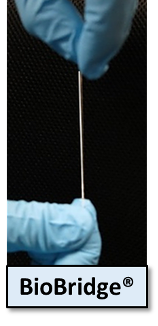
The BioBridge Collagen Matrix is a thread-like, suturable surgical mesh made from highly purified Type I porcine atelocollagen, fabricated using Fibralign's patented Nanoweave technology to recreate the aligned nanostructure of native tissue. It is implanted using minimally invasive technique and is designed to integrate into tissue and fully resorb once its work is done.
Its stated indication is precise. BioBridge reinforces soft tissue where weakness and deficiencies exist, specifically lymphatic tissue repair after or in conjunction with surgical procedures used to address lymphedema, meaning lymph node transfer and lymphaticovenous anastomosis. The manufacturer is explicit that it is not intended to replace normal body structure or to provide the full mechanical strength of a soft tissue repair. It carries a CE mark as a Class III device for the surgical treatment of lymphedema, and it is contraindicated in patients with known sensitivity to porcine products.
The idea: give regeneration a direction
Lymphatic vessels regenerate poorly across scarred or radiated tissue, which is exactly the tissue found in the axilla after breast cancer treatment. The premise behind an aligned collagen scaffold is that lymphatic endothelial cells will migrate along a structured path more readily than through disorganised tissue, so placing threads between the transferred node and the affected limb gives new vessels somewhere to grow.
Preclinical work supports the mechanism. Studies in rodent and rabbit models have reported increased lymphatic vessel density near implanted aligned nanofibrillar scaffolds, and work published in the Journal of Surgical Oncology in 2022 examined enhanced lymphangiogenesis and drainage toward vascularized lymph nodes when scaffolds were added. That is a plausible and reasonably well characterised mechanism.
What the clinical evidence supports, and what it does not
Here the picture needs care. The published clinical material to date consists largely of case series and preliminary results rather than completed randomised trials. Fibralign reports use in more than 60 surgical cases across upper and lower limb lymphedema, with case studies showing reduction in limb volume and new lymphatic formation visualised by near-infrared fluoroscopy and MR lymphography. Case series of this kind establish feasibility and safety signals. They do not establish effect size against a control.
That is what the current trials are designed to answer. The LymphBridge study and a related evaluation in upper extremity lymphedema are both testing whether adding BioBridge to standard vascularized lymph node transfer improves the outcome, with percentage change in excess limb volume at twelve months as the primary endpoint. Until those read out, the accurate position is that the mechanism is supported preclinically, early clinical experience is encouraging, and the comparative question is still open. Any claim stronger than that is not supported.
Where it sits in a surgical programme
BioBridge is not a standalone treatment and does not replace complete decongestive therapy or compression. It is an adjunct placed during an operation that a trained microsurgical team is already performing, which means the real prerequisite is the programme around it: imaging to stage the lymphatic system, surgeons trained in supermicrosurgery, and the follow-up to measure whether anything changed.

What Brainz adds
Brainz supplies BioBridge alongside the microsurgery portfolio that lymphatic work depends on, and supports hospitals building the service rather than buying a single item: product supply, training coordination with the manufacturer, and realistic expectations set before a programme starts. For lymphedema in particular, that last point matters. Teams that begin with clear endpoints and honest evidence are the ones whose results hold up.
If your hospital is developing a lymphedema service, talk to our team about what a first programme should look like.
Product availability, indications, regulatory status and clinical use vary by country and follow manufacturer documentation and applicable regulatory approvals. Trademarks belong to their respective owners.