Mixed Reality Surgery in 2026: Where It Actually Works

Two years ago the honest answer to any question about mixed reality in surgery was that it looked impressive and nobody could say what it was for. That has changed. The technology did not suddenly mature. The field simply got more specific about which parts of it are ready and which are not, and that distinction is now the most useful thing a hospital can understand before it spends anything.
The line the field drew this year
Mixed reality in surgery is really two separate propositions that share a headset. The first is three dimensional review and rehearsal, where the patient model is examined away from the sterile field, before or beside the case. The second is live holographic overlay, where imaging is registered onto the patient on the table and the surgeon looks through the anatomy.
Those two are not at the same stage. Review and rehearsal work today and are being deployed at scale. Live overlay remains constrained by registration accuracy, and the 2026 literature is candid about it. A randomized crossover trial published this year in JMIR Serious Games had 38 participants localize structures on head phantoms and compared superimposing the hologram onto the surgical field against displaying a virtual twin next to it. The superimposed view was limited by overlay accuracy. The adjacent view was not asked to carry that burden.

That is not a disappointing result. It tells a hospital exactly where to put its money, and it is the reason the commercial products that are actually shipping focus on review rather than on looking through the patient.
What the Mixed Reality Viewer does today
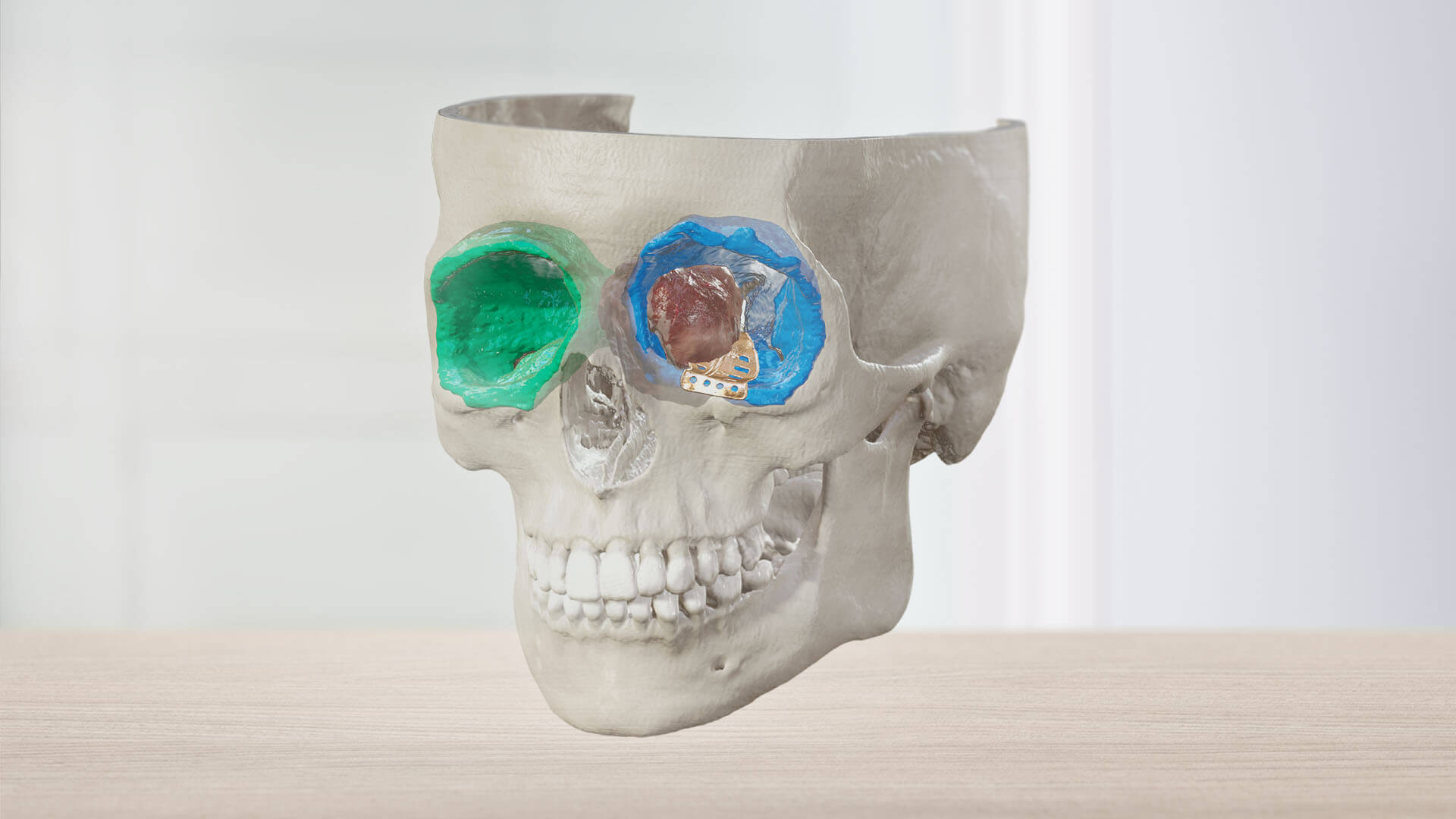
The Brainlab Mixed Reality Viewer sits squarely on the mature side of that line. Patient data is pulled from PACS into the Elements Viewer, a Magic Leap 2 headset is paired by scanning a QR code on the screen, and the clinician steps into a patient specific 3D model. Used together with Brainlab Elements, the model carries automatically segmented anatomical structures rather than a raw volume, which is what makes it useful in minutes instead of hours.
Brainlab publishes indication specific views for cranial, spine, vascular, CMF, functional neurosurgery and SEEG cases. Sessions support multiple participants, including people logging in from a different location, which is how most departments end up using it: a consultant, a fellow and a registrar in the same model, arguing about an approach with something more concrete than a screenshot.
On adoption, Brainlab reports the Mixed Reality Viewer installed in more than 110 hospitals worldwide as of October 2023, and states that in a 34 person customer survey 96 percent felt more prepared for surgery after using it. That is a manufacturer survey with a small sample and should be read as such, but the direction is consistent with what departments describe. Availability differs by country and follows local regulatory status.
Hardware stopped being the excuse
For years the limiting factor was the headset. Magic Leap 2, the hardware behind the Brainlab viewer, now offers a 55 degree vertical field of view, weighs close to a pair of headphones, and keeps its centre of mass near the face to reduce neck strain. Its Global Dimming and Segmented Dimming features are the more clinically relevant part, because they keep digital content legible in a brightly lit room rather than only in a darkened one.
Across the wider field, HoloLens 2 remains the most widely used device in published surgical work, with Apple Vision Pro and Varjo XR-4 now appearing in case reports, including a cardiac ablation at Stanford Health Care where several imaging streams were viewed simultaneously. Reviewers still list the same open constraints: field of view, comfort across a long case, battery life and cost. None of those block planning review. All of them still matter for anything worn through a full operation.
Why the Gulf is an early market for this
Published estimates put the healthcare extended reality market at roughly 11.2 billion US dollars in 2025 moving to around 14.8 billion in 2026, and analysts specifically call out sovereign capital in Dubai and Riyadh funding XR enabled centres of excellence. That matters less as a number than as a signal about how projects here are financed.
There is a structural advantage too. Hospitals in the GCC are frequently commissioned complete rather than upgraded piece by piece, so a visualization layer specified at commissioning costs a fraction of what the same capability costs as a retrofit three years later. And the value is not confined to the operating room. A systematic review of preoperative informed consent found that immersive review improved patient understanding and satisfaction and reduced anxiety, which is a real benefit in a region where a large share of complex cases are second opinions and the consent conversation carries weight.
How to start without overcommitting
The sensible entry point is the proven one. Put mixed reality where the department already reviews plans: complex cranial and spine cases, tumour boards, teaching, and consent for difficult operations. Three things have to be in place. Imaging good enough to build a clean 3D model, segmentation that runs automatically rather than by hand, and one or two clinicians who will actually own it. Departments already running automated planning in Brainlab Elements have the first two solved.
Brainz handles evaluation on your own cases, integration with the planning and navigation platform already in the department, and the training that decides whether a headset becomes a working tool or a drawer ornament. If you want the broader background first, our earlier piece on mixed reality in the operating room covers the fundamentals. When you are ready to see it on your own patient data, arrange a session.
Product availability, indications, regulatory status and clinical use vary by country and follow manufacturer documentation and applicable regulatory approvals. Trademarks belong to their respective owners.