Thyroid Surgery and the Recurrent Laryngeal Nerve: What Continuous Monitoring Changes
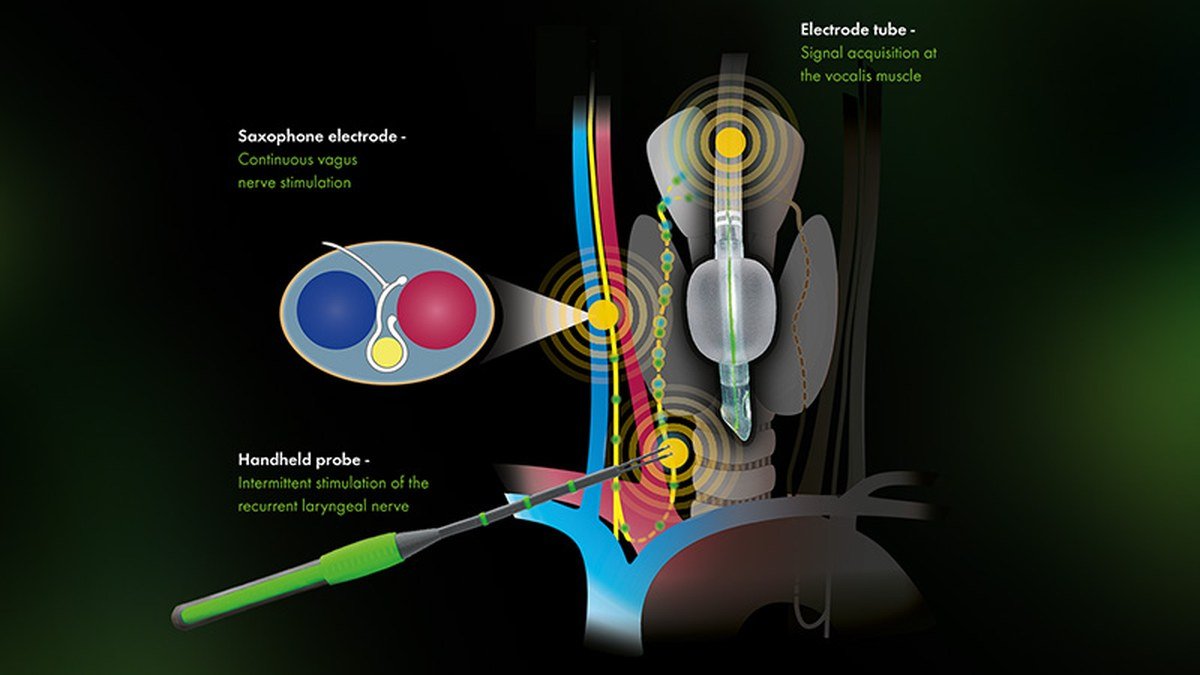
Every thyroidectomy carries the same quiet risk. The recurrent laryngeal nerve runs millimetres from the gland, it controls the vocal cord, and a patient who wakes with a weak or paralysed cord may live with a changed voice, swallowing difficulty or, after bilateral injury, a compromised airway. Langer Medical notes that more than 100,000 thyroid operations are performed every year in Germany alone, which is 100,000 chances to protect that nerve or miss it.
Intraoperative neuromonitoring (IONM) has been part of modern thyroid surgery for about fifteen years. What has changed recently is the shift from checking the nerve to watching it. This piece explains the difference, what the current guidelines say, and how it works in practice with the Langer Medical systems Brainz represents in the UAE and the GCC.
Intermittent monitoring tells you what happened
Conventional IONM is intermittent. The surgeon touches a handheld probe to the nerve, a small current pulse travels along it to the vocalis muscle, and an electrode on the endotracheal tube records the muscle response. Stimulating the vagus nerve tests the recurrent laryngeal nerve along its entire length, and in a standard case one stimulation before resection and one after is enough to document that the nerve still conducts.
The limitation is timing. Intermittent stimulation only reports on the moment the probe touches the nerve. Traction from a retractor, heat from an energy device, or stretch during mobilisation of a large goitre can injure the nerve between two checks, and the surgeon finds out only when the final stimulation is silent.
Continuous monitoring tells you what is happening
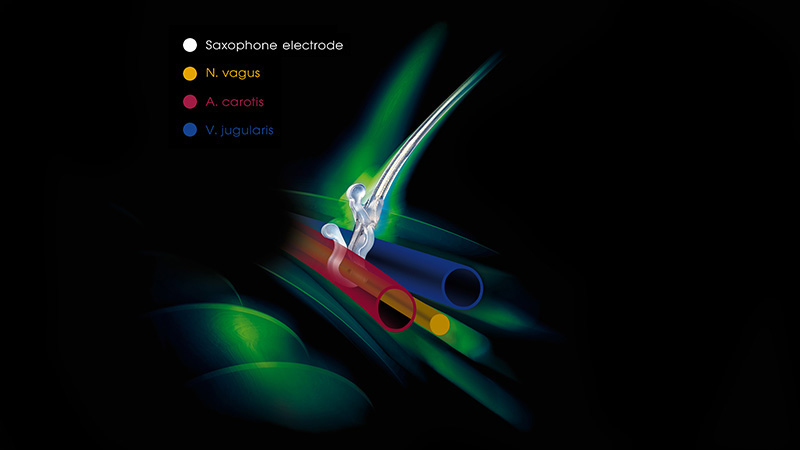
Continuous IONM changes the question. A bipolar electrode is placed around the vagus nerve, away from the dissection, and the neuromonitor stimulates it repeatedly while the surgeon works. Each stimulus produces a response, and the system tracks two parameters over time: the amplitude of the signal and its latency. A fall in amplitude combined with a rise in latency is the recognised warning that the nerve is under strain, and in published series most of these events reverse when the surgeon releases the manoeuvre that caused them. The nerve is warned about, not reported on.
Langer Medical was one of the pioneers of this method. Its saxophone electrode takes its name from its shape: a flexible, open design that encloses the vagus without compressing it, while keeping enough contact for stable stimulation and a clean signal. The Avalanche systems display long term trend lines for amplitude and latency, allow the team to pre-programme audible alarms for critical changes, and save the full recording so that an unexpected event can be reviewed after the case and compared with others.
The safety question has been studied directly. A 2023 analysis of continuous vagus stimulation during thyroid surgery found only a mild electrophysiological effect on the vagus and recurrent laryngeal nerve axis, with differences the authors judged negligible and not linked to clinical outcomes.
Loss of signal is now a defined event with a defined response
The International Neural Monitoring Study Group (INMSG) guideline of 2018 gave surgeons a shared vocabulary. A satisfactory baseline is an amplitude above 500 microvolts. Loss of signal means a response of 100 microvolts or less at 1 to 2 milliamps on a dry field, together with loss of laryngeal twitch or glottic movement. The guideline also distinguishes a segmental injury at one point on the nerve from a global loss with no identifiable lesion, because the two carry different prognoses.
The most important practical consequence is staging. If signal is lost on the first side of a planned bilateral operation, the guideline recommends the surgeon consider stopping and completing the second side later, once the first cord has been assessed, rather than risk bilateral palsy. An INMSG survey published in 2024 found that surgeons staged the operation in 85 percent of first side loss of signal cases involving benign disease or low risk cancer, and proceeded to total thyroidectomy in the 15 percent involving advanced carcinoma. Continuous monitoring supports this decision because it shows the event as it develops and gives the team a documented trace to act on.
Where the field stands in 2026
The technique is mainstream, and the discussion has moved to standardisation. A survey of Spanish endocrine surgeons published in Scientific Reports in March 2026 found that 75 percent consider IONM the gold standard in thyroid surgery and 77 percent would require their own surgeon to use it. At the same time, 80 percent treat a combined amplitude decrease and latency increase as an alarm, yet more than a third were unaware of the difference between segmental and global loss of signal, and one in five had never adopted the INMSG recommendations. The European Society of Endocrine Surgeons has responded with a 2026 consensus statement on standardisation and research requirements for nerve monitoring in endocrine surgery.
The lesson for a hospital building or upgrading a thyroid programme is that the equipment is the easy part. The value comes from a team, surgeon, anaesthetist and nurse together, that places the tube electrode correctly, records a proper baseline, agrees in advance what an alarm means and what the response to loss of signal will be, and documents all of it. This is also why continuous monitoring is spreading into robotic and remote access thyroidectomy, where a 2026 systematic review found it adds operative time but supports identification and preservation of the nerve in an approach with less direct visual access.
How Brainz sets this up in the GCC
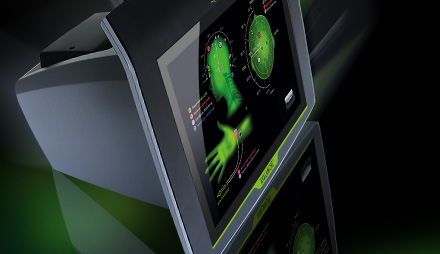
Langer Medical, now part of the Brainlab group, builds its neuromonitors in Waldkirch, Germany. For thyroid, parathyroid, ENT and maxillofacial surgery the platform is the Avalanche SI 2, an 8-channel monitor with built in stimulators, a touchscreen glass front designed for OR hygiene, and LAN and WLAN connection to the hospital information system so that trend data goes into the case report. For neurosurgery and spine the 32-channel Avalanche PLUS covers the higher channel counts those cases need, so a hospital can standardise on one manufacturer across departments.
Brainz supplies the monitor together with the consumables that make continuous monitoring work: the saxophone vagus electrode, the electrode tube that combines intubation and lead placement in one step, the adhesive tube electrode for existing tubes, and the range of monopolar and bipolar stimulation probes. Installation includes training for the surgical and anaesthesia team on electrode placement, baseline recording and the INMSG loss of signal protocol, with clinical application support for the first cases and ongoing service afterwards.
If your hospital performs thyroid surgery and wants to move from checking the nerve to watching it, talk to us. For the wider picture of nerve protection across neurosurgery and spine, see our earlier piece on intraoperative neuromonitoring and the specialties Brainz supports.
Product availability, indications, regulatory status and clinical use vary by country and follow manufacturer documentation and applicable regulatory approvals. Trademarks belong to their respective owners.