Awake Craniotomy Programs: The Team, the Mapping and the Technology
Awake craniotomy is one of the few operations in which the patient is part of the surgical team. When a glioma sits in or beside the cortex and white matter that carry speech and movement, the surgeon can wake the patient during the resection, ask them to name pictures or move a hand, and stimulate the brain to see which areas must be left alone. The technique is decades old. What has changed is how much of the work now happens before the day of surgery, and how much technology sits around the operating table.
This piece looks at what a working awake program is made of, what the 2026 literature adds, and where navigation and preoperative mapping fit. It is written for neurosurgery departments and hospital leaders in the UAE and the wider GCC who are building, or expanding, this service.
An awake program is a team before it is a technique
The operation depends on people more than on any single device. A functioning awake program usually brings together the neurosurgeon, a neuroanesthesiologist who can keep the patient comfortable and then cooperative, a neuropsychologist or speech and language therapist who designs and runs the tasks, a neurophysiology technologist for monitoring, and nurses trained to talk the patient through each stage. Patient selection matters just as much: the patient must understand the plan and be able to take part.
The tasks themselves are a growing area of research. A 2026 paper in Frontiers in Oncology describes a new high-resolution language test battery for awake craniotomy in neurooncologic patients, with preliminary perioperative results. The direction is clear: better designed tasks, chosen for the tumor location, so that the awake window is spent testing the functions that are truly at risk.
What the 2026 evidence says, and what it does not
Several systematic reviews published in 2026 compare awake craniotomy with general anesthesia for glioma resection, including one focused on high-grade tumors. They are worth reading in full, and the honest summary is that the choice remains an individual one, based on tumor location, the functions at risk and the patient.
Single-center series add detail on outcomes. A 2026 study in Diagnostics followed 37 patients with malignant glioma in the dominant hemisphere who had awake surgery with intraoperative mapping. Postoperative language worsened in six patients (16.2 percent) and stayed stable in 31. Older age was associated with higher odds of worsening, and the authors point out that the sample is small and call for larger prospective studies with standardized assessment. A 2026 Journal of Neurosurgery paper on speech mapping in awake high-grade glioma resection looks at proximity to subcortical tracts as a predictor of language outcome, which is a reminder that the white matter matters as much as the cortex.

Preoperative mapping: preparing for the awake day
Intraoperative cortical and subcortical stimulation stays the reference for finding eloquent tissue while the patient is awake. Preoperative mapping does something different: it tells the team where to look, and how to shape the approach, before the patient is on the table.
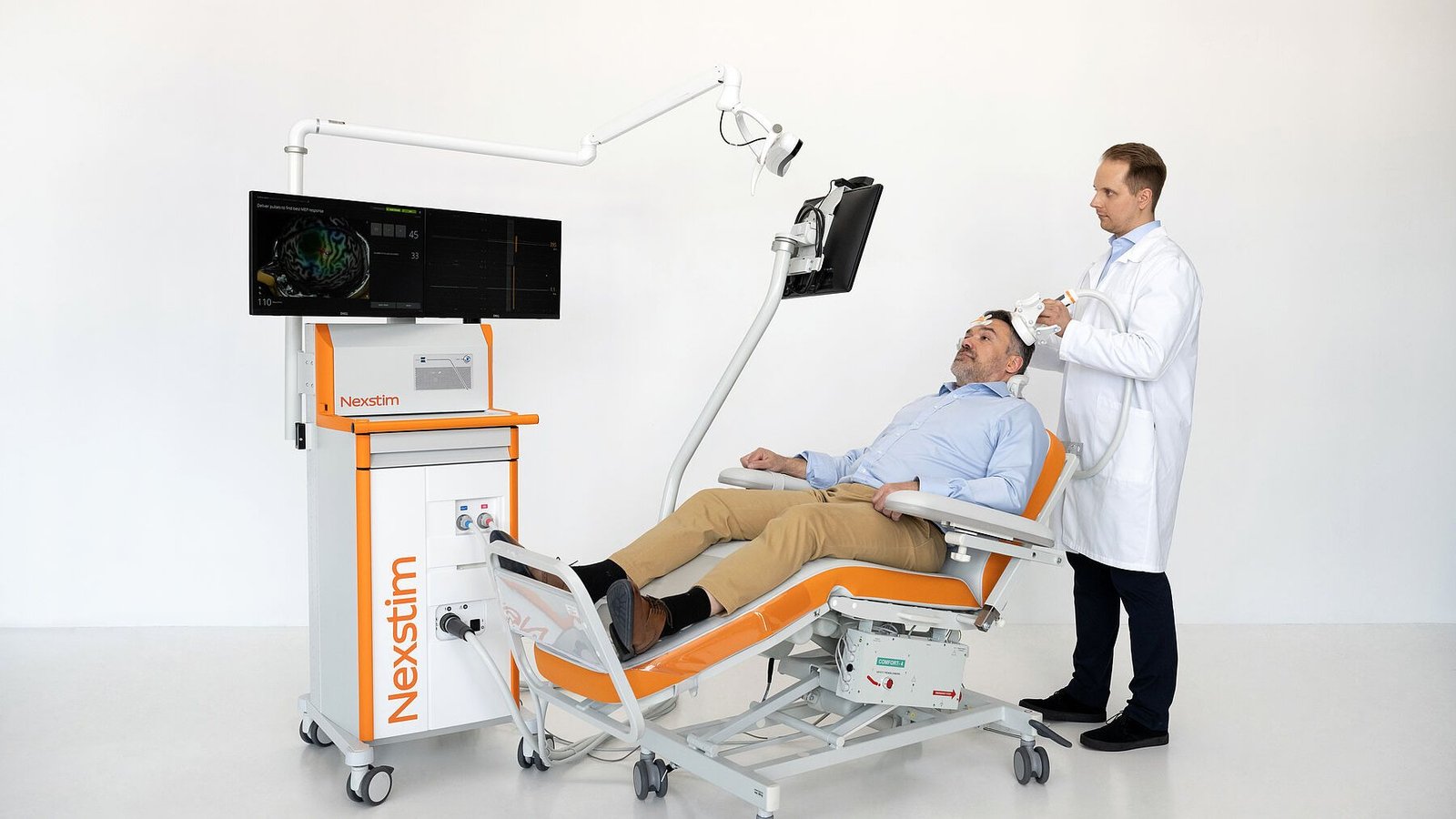
Navigated transcranial magnetic stimulation (nTMS) does this non-invasively. Nexstim's NBS system uses the patient's own 3D MRI to map the primary motor cortex, and the NexSpeech module localizes cortical speech areas. The maps sit alongside the tumor in the plan, so the team can see the relationship between the lesion and eloquent cortex, decide which patients are good candidates for an awake approach, and prepare the task set. We describe the workflow in our earlier pieces on navigated brain mapping and NexSpeech language mapping.
The published evidence is encouraging, with limits. A 2026 systematic review and meta-analysis in Open Medicine pooled five studies with 736 patients and found higher rates of gross total resection with nTMS (odds ratio 2.03, 95 percent confidence interval 1.27 to 3.25) and lower rates of subtotal resection, with no significant difference in postoperative motor function or Karnofsky performance status between groups. In the multimodal comparison, nTMS combined with subcortical stimulation and neuromonitoring was associated with an absolute increase in gross total resection of 12 to 18 percent and lower permanent motor paresis (3 to 6 percent versus 9 to 14 percent), although only one study reached statistical significance for neurological outcomes. It is supportive evidence, drawn from a small number of studies, and it does not replace intraoperative mapping.
Navigation and monitoring keep the plan and the patient aligned
Once the maps exist, they need to reach the operating room. Nexstim's motor and speech maps export into Brainlab Elements, where they can be combined with fiber tracking, tumor outlining and trajectory planning. In theatre, Brainlab Curve, a mobile 4K touch cart, lets the team plan, navigate, visualize and document the case from one platform, so the surgeon sees the plan and the mapped functional areas in the same view as the instruments.

Neuromonitoring completes the picture. Langer Medical systems assess and localize motor and sensory nerves during surgery, running alongside navigation. In an awake case, monitoring and direct patient testing are complementary: one is continuous and objective, the other tests functions that only an awake patient can perform. Our overview of intraoperative neuromonitoring covers the principles.
What a hospital needs to start
A sensible route is to build in steps. Start with the team and the protocol: patient selection, anesthesia approach, the task battery and the roles on the day. Add preoperative mapping and planning so that awake cases are prepared consistently. Then connect navigation and monitoring so that the plan, the maps and the signals are available at the table. Each step improves the program on its own, and none of them depends on buying everything at once.
Brainz supports neurosurgery departments across the region with installation, training, clinical support and after-sales coordination for the Nexstim and Brainlab platforms, and can help a team scope which pieces fit their current volume. See our neurosurgery page for the full solution area, or talk to us if you are planning an awake program.
Product availability, indications, regulatory status and clinical use vary by country and follow manufacturer documentation and applicable regulatory approvals. Trademarks belong to their respective owners.